
Search Detroit Streets by Address
Start with the parcel, not a name list. The Detroit city parcel map links an address to a parcel ID, map location, surrounding lots, and an owner or taxpayer snapshot. It also carries sale data, zoning, and imagery. The parcel ID matters because Detroit mailing addresses change. A taxpayer on a Detroit record may be an owner, business, trust, lender, or agent. It is not a roster of everyone there.
Build the Detroit address trail in date order. Early steps establish the current property record, while later ones add recorded documents and historical sources. Save each result with its search date and the address form used. Directional prefixes, units, and former numbers make that habit worth keeping on any Detroit street.
- Search the address in the Detroit Parcel Viewer. Confirm the street spelling, parcel ID, map position, nearby lots, and the date of any imagery.
- Run the same address in the Wayne County Treasurer property tax listing. It can search by street number and name, municipality, or parcel ID and is useful for delinquent-tax context.
- Use Detroit BS&A with its Address, Name, or Parcel Number modes to compare the assessment and tax details.
- Check Detroit Accela for address, parcel, owner, record, or licensed-professional entries. Permit dates describe work on a property, not a list of occupants.
- Use the owner name, legal description, or parcel reference in the Wayne County Register of Deeds search to trace recorded instruments.
- For an older address, compare a reverse directory, map, or assessor card after first translating pre-1921 numbering.
Note: A Detroit street search works best when each result is dated and checked against the parcel's situs address. Skip unrelated mailing addresses.
Detroit Parcel Viewer for Street Context
The Detroit Parcel Viewer accepts an address or parcel ID. A map click also selects a lot. Its public parcel detail can show the address, owner or taxpayer, sale and value information, dimensions, acres, and zoning. It can also show the building count. A satellite view and Street View come built in. The parcel outline is drawn on the map as well. Clicking lots makes it practical to inspect the next parcel on a block. This avoids turning a broad Detroit street query into a speculative people list.
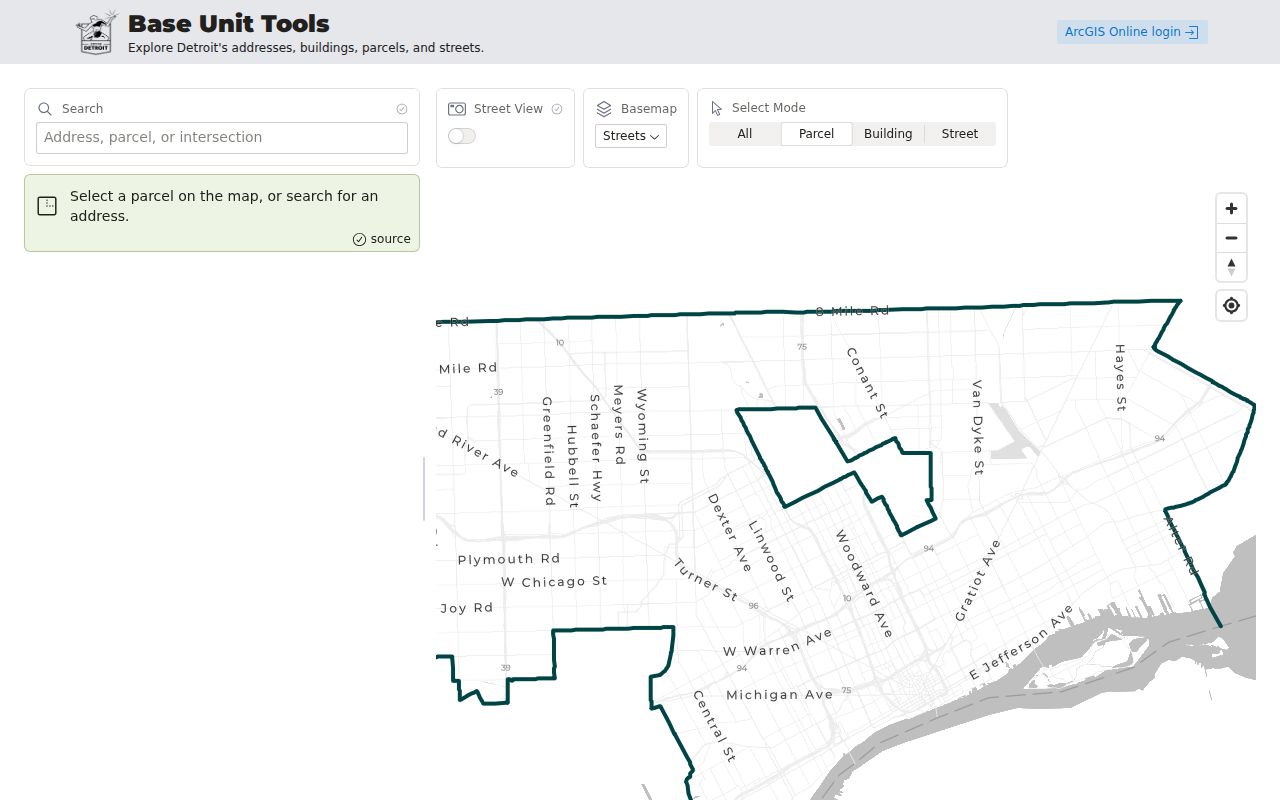
The map anchors any Detroit street directory trail. The selected parcel supplies the stable identifier used to compare assessment, tax, and recorded-document results. Without it, later systems do not line up.
Detroit parcel boundaries follow an annual assessment and GIS revision cycle. A map snapshot and an assessment record may reflect different update points. A corner parcel may use one street for mailing and another in its legal description. Check the geometry and the situs field first. Two address forms are not always a mismatch.
Detroit Street Directory Search Fields
Detroit's address tools do not agree on input. Each public portal asks for different fields. Start with the smallest useful search. Widen it only if nothing comes back. BSEED advises beginning a Detroit Accela address query with the street number and street name. Direction, type, unit, city, state, ZIP, and parcel stay blank when a narrow search fails.
| Portal | Field or control | Required | Detroit search note |
|---|---|---|---|
| Wayne Treasurer | Street Number | Optional | Leaving it blank can search the whole street. |
| Wayne Treasurer | Street Name | Practical requirement | Use at least three letters; a suffix may be omitted. |
| Detroit Parcel Viewer | Address or parcel ID | Optional | Map click and zoom are alternate controls. |
| Detroit BS&A | By: Address, Name, Parcel Number | Yes | The selected mode determines the search field. |
| Detroit Accela APO | Address, Parcel Information, Owner, Record Information, Licensed Professional | Yes | Use a separate mode for each question. |
The Detroit BS&A municipality page is the clearest property entry point. The situs field is the property address. The mailing field shows where a notice is sent. Detailed records can also expose property, tax, building, utility, land and legal-description, sale, and map actions where those services are available.
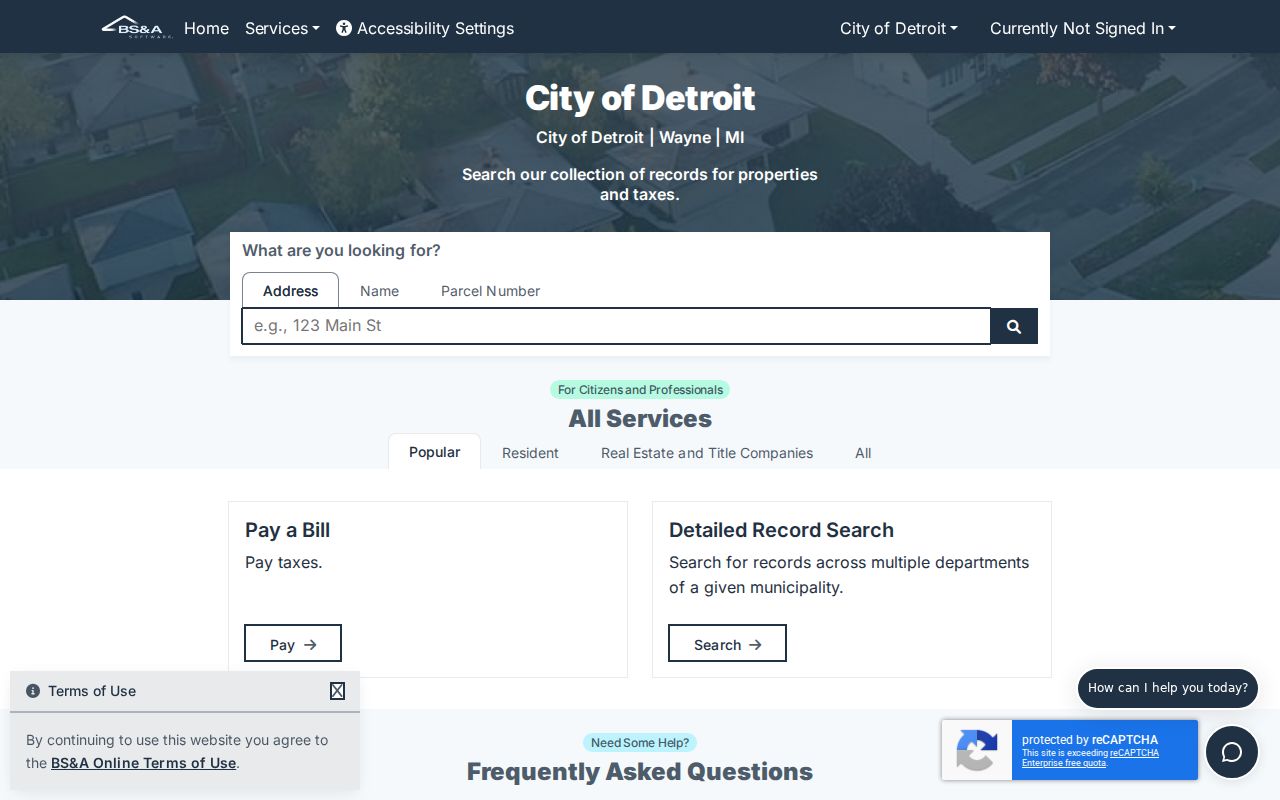
The BS&A screen shows why a Detroit by-address search should record both the displayed parcel number and the chosen search mode. Keep them before moving to another record system.
Detroit Tax and Permit Address Records
The Wayne Treasurer listing is a separate county tax route for Detroit property. It reports delinquent-property-tax information and payment options, not a full title chain. Choose Detroit when useful. Search by address or parcel ID. Keep the punctuation shown for a Detroit parcel identifier. The county documents a period or dash at the ninth position. A broad Detroit street check is also possible. The Treasurer's guidance permits a blank street number with a street-name prefix.
The Wayne County Treasurer property-tax listing exposes the address and parcel-ID entry path. Use that path for Detroit property-tax searches. Start there for tax questions.
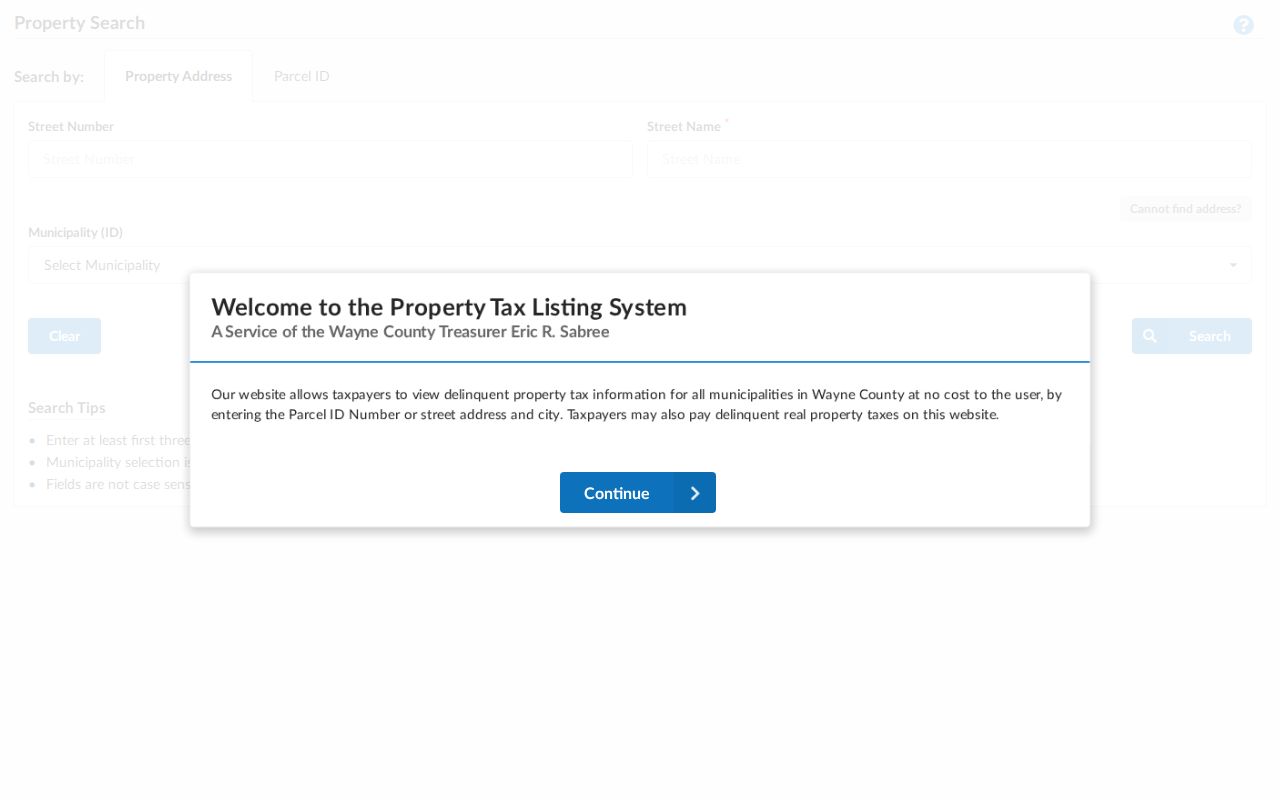
Tax results can point to a parcel worth checking in BS&A or the deed index. Delinquency does not establish possession or household membership.
Detroit Accela adds a different layer. Its public property lookup offers modes for address, parcel information, owner, record information, and licensed professionals. A Detroit permit may include the property address, scope of work, valuation, applicant or authorized-agent information, inspections, and a final certificate. Use permits to date construction or alteration activity. Never treat an application as proof of residence.
Wayne Deed Trails from Detroit Addresses
The Wayne County Register of Deeds anchors the Detroit record trail for deeds, mortgages, liens, plats, and related instruments. Save the current parcel ID first. Pull the legal description and owner from BS&A. Then search the recorded-document system by the available route. The free public search is name-only and gives index listings without images. Paid expanded access accepts an address, legal description, parcel or tax ID, and liber and page, while office kiosks and mail search cover other needs.
The Wayne County Official Records Search is the current GovOS landing page for the deed index and Property Alert service. It is the free entry point.
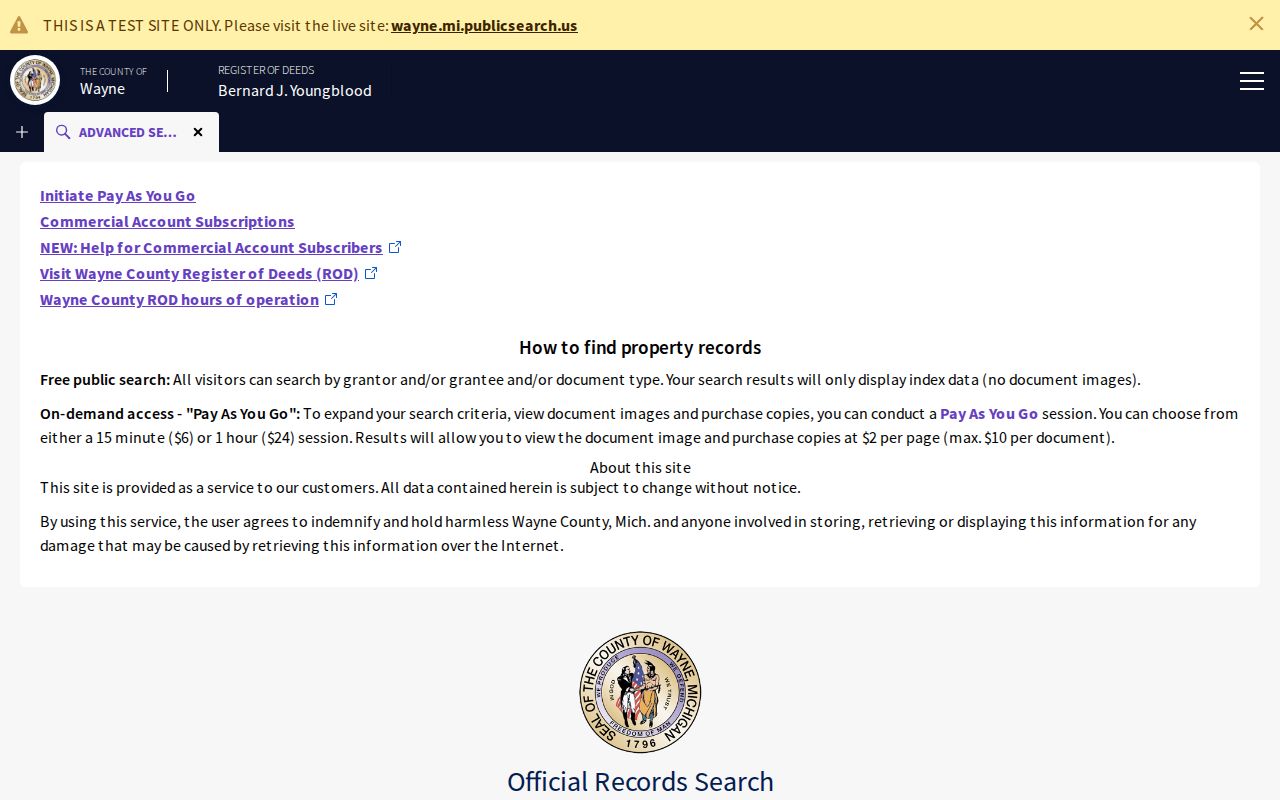
Track the document details that anchor each deed: instrument type, recording date, document number, grantor, grantee, legal description, and the liber and page. The liber and page appear when the entry shows them. The grantor is the party giving up an interest in the Detroit property. The grantee is the party taking it. Search each newer grantee as a grantor in earlier years. The chain walks backward one transfer at a time.
A recorded Detroit deed proves who held title. It does not prove who actually lived in the house on a given day. Occupancy and ownership can diverge, so pair deeds with directory evidence before drawing conclusions. The Register's public web coverage reaches back to January 1, 1960. County material also describes where electronic indexing and imaging begin after August 1986. For anything older, the office's tract and deed books remain the right tool. The history is often there even when the online index stops.
Detroit's 1921 Street-Number Change
Every old Detroit address carries one hidden trap. The city renumbered its houses on January 1, 1921. A number from before that date simply does not match a modern one. Feed it straight into a Detroit parcel search and you will get a false result. Translation comes first, always.
The 1920-1921 directory reprint solves much of this. Its volumes five and six, pages 2357 through 2807, give old and new reverse-address material side by side. The Detroit Department of Public Works map archive adds a 1921 street-name-change folder. It is useful because some streets changed names at the same time their numbers changed.
Track every piece separately. Note the old number, the translated number, each street-name version, the volume and page, and the modern parcel candidate. That discipline keeps a good Detroit street directory hit from landing on the wrong current address. It also clears up a common mystery. That is when a deed or a name seems to vanish from a lot that never moved.
Note: Run any pre-1921 Detroit address through an old-to-new number check before searching a modern parcel or tax portal.
Detroit Reverse Address Sources
Historical reverse sources turn a Detroit address into a dated household clue. The Detroit Public Library's Burton Historical Collection holds Detroit directory runs for 1845-1846 and 1850-1941, then selected east or west editions from 1953 through 1974. The post-1941 holdings are not a complete annual run. Ask Detroit staff for the year and address rather than inferring coverage from a neighboring volume.
The Library of Congress street-address inventory identifies Detroit street-address directories for 1942, 1944-1945, 1953-1974, 1977, and 1980-1981, plus Detroit City criss-cross coverage for 1946 and 1976-1994. A criss-cross directory is a reverse directory arranged by street and number. It can place a name at a Detroit address in the edition year. For the wider historical collections and how to read an entry, use the Detroit city directory page.
- Parcel
- A city-defined unit of land identified by a parcel number.
- Situs address
- The physical property address, distinct from an owner or taxpayer mailing address.
- Plat
- A recorded subdivision map that can identify a lot and block when an address has changed.
- Criss-cross directory
- A historical reverse directory that organizes entries by address rather than surname.
Detroit Street Records Compared
No single source answers every Detroit street directory question. Parcel and assessment tools nail the property identifier and the named taxpayer. The deed index covers recorded transactions. Permits date the work. Reverse directories and maps supply the historical address context. Woven together, these records build a documented sequence without turning public files into a current list of private people.
| Detroit address record | What it can show | Access channel | Key limit |
|---|---|---|---|
| Assessor and BS&A | Situs, parcel, taxpayer, legal and value fields | Online, assessor office, email | Current assessment snapshot |
| Parcel Viewer | Parcel outline, map context, owner or taxpayer, zoning | Public map and parcel click | Owner and occupant are different facts |
| Wayne Treasurer | Address or parcel tax listing and delinquency context | Free online search | Not a complete title record |
| Register of Deeds | Grantor, grantee, instruments, legal description | Free name index, paid mode, kiosk, mail | Older research may need tract books |
| Accela permits | Recorded work, dates, applicant and permit fields | Public property lookup | Permit activity is not occupancy proof |
| Reverse directories | Historical address-to-name clue | Burton, Library of Congress, catalog access | Coverage gaps and numbering changes |
When an online Detroit search hits a wall, step over to the documented fallback. Avoid unofficial profile sites. The Register offers walk-in kiosk use and search-by-mail. Burton, along with the Archives of Michigan Wayne County guide, opens historical research paths. The city's older records become reachable through those paths. A Michigan Freedom of Information Act request must describe the Detroit city record clearly enough to locate. Permitted search, review, separation, copying, and mailing costs may apply.
Detroit Voter Data Does Not Browse Streets
Michigan keeps voter registration open to the public. But the Michigan Voter Information Center serves a narrow purpose. A person uses it to confirm personal registration. They can also find a clerk or check a polling place. The name route demands first and last name, birth month and year, and ZIP. It simply is not a Detroit street directory. You cannot browse a Detroit block through it.
A Qualified Voter File request works differently. It offers controlled geographic options and a fixed field set. Sensitive items stay withheld. These include license and state-ID numbers, birth month and day, phone, email, signatures, and the last four digits of a Social Security number. The state's voter-registration guidance spells out the public-record rules and how to submit a request. Remember that any voter record is a snapshot. It does not prove someone lives at an address today.
Limits of a Detroit Street Directory
Detroit publishes no official, stable resident roster covering the whole city. One parcel can sit vacant, hold several addresses or units, or shelter an institution. The taxpayer may even list a different mailing address. Utility customer lists exist as no public lookup. Historic maps and permits describe buildings and work, never a full household. So a missing name might mean a gap in a directory. It could signal a changed address. Or it might simply be a record made for another purpose.
Michigan runs an Address Confidentiality Program. It gives a substitute address and mail forwarding to people facing a risk of physical harm. Never try to reverse such an address. Never trace a protected Detroit resident through connected records. Keep public materials to lawful personal research. Note each source and date. Send corrections to the office that holds the record.