
Detroit City Directory Collections
Detroit's historical shelf is distributed among a local reading room, national library locators, and digitized scans. The Burton Historical Collection at Detroit Public Library holds Detroit directories for 1845-46 and 1850-1941, followed by selected east or west editions from 1953 through 1974. The Library of Congress separately lists reverse street-address directories and criss-cross editions. FamilySearch and Google Books provide early digital entry points. Each collection answers a slightly different question, so record the collection name before treating a search result as a full citywide run.
| Detroit collection | Documented years | Holding route | Useful access |
|---|---|---|---|
| Burton city directories | 1845-46; 1850-1941; selected 1953-74 editions | Detroit Public Library, Burton | Reading-room research for names, addresses, firms, and reverse pages |
| Polk Detroit run | 1886-1974 | Library and institutional holdings cited by federal HABS | Check the actual volume and its geographic edition |
| Street-address directories | 1942; 1944-45; 1953-74; 1977; 1980-81 | Library of Congress locator | Address-to-name research, with incomplete annual coverage |
| Criss-cross directories | 1946; 1976-94 | Library of Congress locator and local repositories | Reverse address clue, not a continuous series |
| MacCabe volumes | 1837; 1857-58 | Google Books and FamilySearch Library | Digitized catalog or scan access |
The gaps matter. Burton's post-1941 material is not an annual sequence, and several later holdings are split east or west. A surname missing from a selected edition may be a geography or edition issue. It does not establish that the person left Detroit. Detroit collection gaps are facts to cite, not empty space to fill with a guess.
Burton's Detroit Directory Run
Burton is the main local fallback when a web search stops. Its Detroit holdings go beyond directories to maps, newspapers, photographs, family histories, church records, military material, obituaries, and land references. The reading room is at 5201 Woodward Avenue. DPL lists it as closed Monday; Tuesday through Saturday service is available from 2 to 6 p.m. without an appointment, with appointment slots at noon and 6 p.m. Sunday hours are listed as 1 to 5 p.m. from October through May. Check the current Detroit library page before a visit because database and reading-room access can change.
See the Burton Historical Collection's research page for its current access information and collection scope.
The Burton route is especially useful when a Detroit directory name needs to be tested against local newspapers, church materials, an obituary index, or a Detroit map from the same period.
Detroit Digital Collection Paths
Early volumes offer useful entry points. Google Books digitizes Julius P. Bolivar MacCabe's 1837 Directory of the City of Detroit, with Its Environs, and Register of Michigan, a 114-page volume. FamilySearch catalogs MacCabe's 1857-1858 Detroit directory as a 365-page public record, identifier 1936044. Capture the title, creator, year, catalog identifier, and page image. OCR can miss initials in Detroit names and street abbreviations, so the image remains the record to compare.
The FamilySearch catalog record for the 1857-1858 directory shows the bibliographic details for that digitized volume.
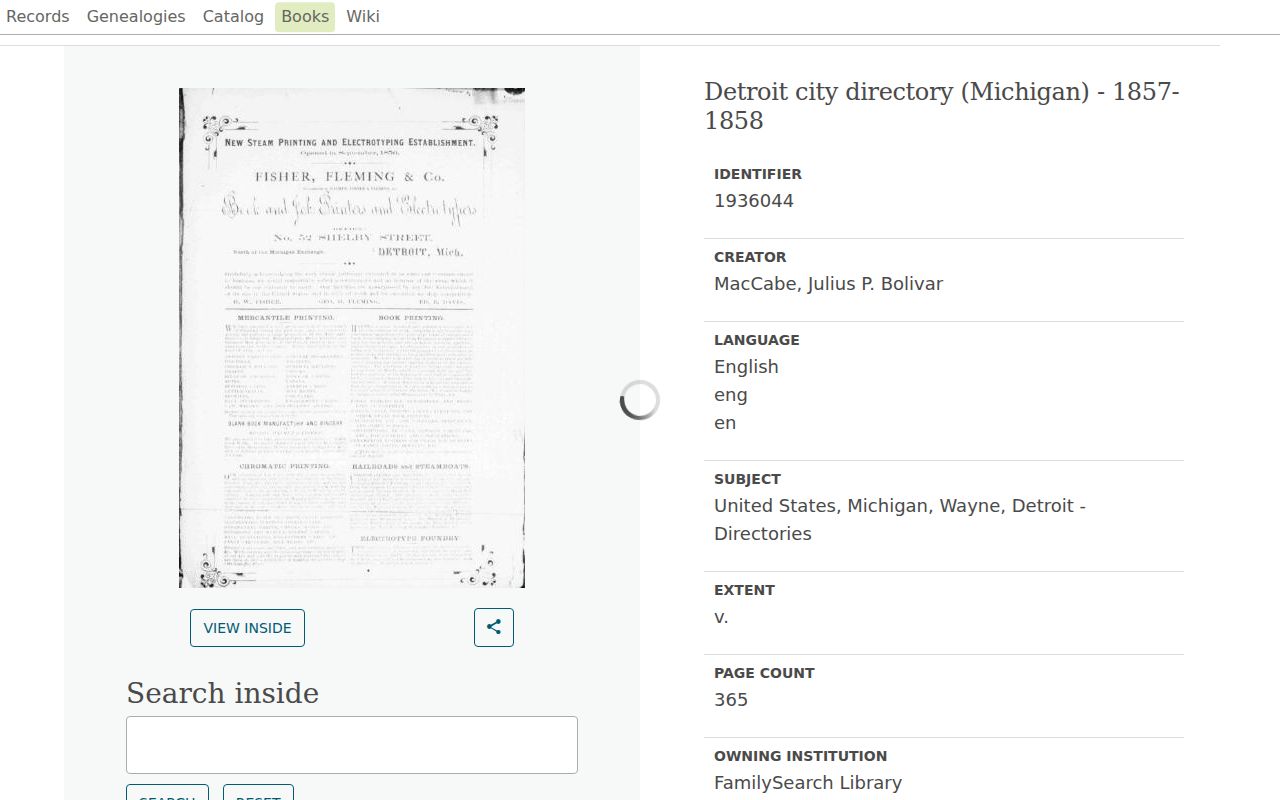
That catalog record is a solid starting point for the Detroit edition, but page-level checking is still needed when transcribing a Detroit person or address.
Detroit Public Library Digital Collections supplies keyword and advanced search across Burton and other named collections. Its facets include Burton, E. Azalia Hackley, automotive history, rare books, and other material. It is best used for photographs, manuscript files, maps, and local-history clues rather than as a guaranteed name index.
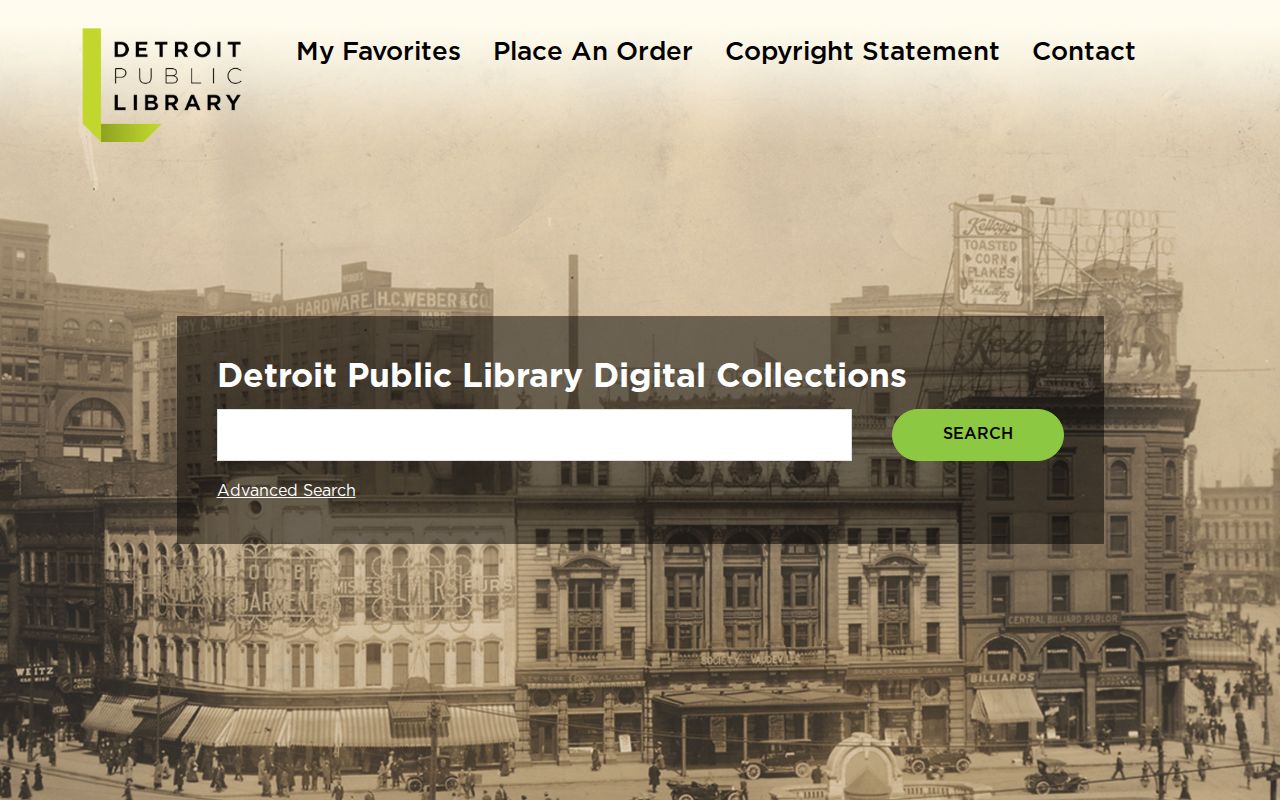
A Detroit collection search can supply an image, a business clue, or a street context that helps identify the right Detroit directory entry and year.
Reading Detroit City Directory Entries
A Detroit directory entry is compact and its conventions vary by volume. A 1912 FamilySearch transcription reads: “Wm. H. King (King & Bergmoser), h 1361 Van Dyke Av.” It identifies a name, a firm association, the home marker h, and a street address. It does not state an occupation label or spouse, so neither should be added from the firm name. Look first for the volume's own abbreviation list. Then compare the alphabetical entry with any reverse street section.
| Person name | Surname, given name, initials, and sometimes a household or spouse notation |
|---|---|
| Firm or occupation | A business, employer, or occupational clue when the entry actually prints one |
| Home notation | h in the 1912 example means home; wording and abbreviations can vary by volume |
| Street address | Number, street name, and often an abbreviated street type, tied to that publication year |
| Cross-reference | A business or name reference that may point to another entry, not proof of a second address |
- Criss-cross directory
- A reverse directory arranged by street and number so an address can lead to a listed name.
- Householder index
- An index arranged around a household or address convention that should be checked in that edition's front matter.
- Abbreviation key
- The volume's own explanation of short forms. Photograph or note it before expanding a mark in your notes.
Detroit Reverse Address Editions
Name indexes are only one side of the historical record. The Library of Congress lists Detroit street-address directories for 1942, 1944-45, 1953-74, 1977, and 1980-81. Its criss-cross inventory lists Detroit City for 1946 and 1976-94. These are locator entries for national holdings, not proof that every listed Detroit issue is at Burton. Use the locator to identify the Detroit year, then confirm the physical or digital holding with the relevant library.
The Library of Congress criss-cross directory guide is the documented route for those reverse-address years.
Reverse editions are valuable for a historical address search, but they should be read alongside the edition's coverage statement. A street may be absent, split by side, or listed under a former name.
Detroit's 1921 Address Bridge
Detroit's reformed street-numbering system took effect January 1, 1921. The 1920-21 directory reprint includes old and new address material in reverse-address volumes five and six, pages 2357-2807. That bridge is essential when a pre-1921 house number does not appear in a current parcel map or later directory. Keep the original number, translated number, street-name form, volume, and page in separate notes. A current-looking address should never be projected backward without that check.
The city's 1921 street-name-change folder provides another documented source when a street itself changed names. This local numbering story often explains an apparent gap in a family's Detroit trail.
Detroit Directory Dates
The date range is long, but it is not a smooth annual line. Treat these landmarks as selection points for a source search, not a promise that every household appears every year.
| Date or span | Detroit directory landmark |
|---|---|
| 1837 | MacCabe's 114-page Detroit directory was published by William Harsha. |
| 1845-46; 1850-1941 | Burton's documented core directory holdings. |
| 1857-58 | MacCabe directory cataloged by FamilySearch as a 365-page public volume. |
| 1886-1974 | R. L. Polk & Company Detroit City Directory span cited in federal HABS material. |
| 1953-74 | Burton's documented selected east or west issues, not a complete annual run. |
Those numbers help explain why one find can be strong while the next year is unavailable. The edition and the holding are part of the citation.
Tracing Detroit City Directories
A careful Detroit family-history search moves backward or forward one documented directory year at a time. It keeps a record of the address, occupation or firm, household wording, and the edition used. Pairing the Detroit sequence with released census schedules adds household composition and age information without pretending both sources were collected on the same day.
- Start with the latest documented Detroit entry that fits the known name or address, and record the exact edition.
- Check surname variants and initials in the alphabetical section, then copy the address and every printed notation.
- Use the reverse section when it exists to check the street and historical number for that same year.
- Repeat through the next available collection year, allowing for Burton gaps and east or west editions.
- Compare nearby directory years with the 1900, 1910, 1920, 1930, 1940, or 1950 census when the released schedule fits the period.
Federal census schedules follow a 72-year release rule. A census gives a dated Detroit household snapshot; a directory often gives urban address continuity. A difference can reflect timing, a move, or the source's own coverage.
Detroit Structures and Sources
When a Detroit name is unclear, use context without turning a building record into an occupant claim. Library of Congress Sanborn materials can show Detroit building footprints, materials, stories, use, lot shape, alleys, and adjacent addresses across documented editions. The 1889 Detroit volume has 84 sheets. It can help confirm that an old Detroit number belongs to the same structure, but it does not name the people who lived there.
The Library of Congress Sanborn guide explains the atlas-volume finder, while DPL's Digital Sanborn database is documented as available from DPL computers. For household clues, Burton's Detroit Free Press database covers 1831-1999, and its Michigan Chronicle access includes 1936-2010 and 2006-present entries under the library's stated access conditions.
Detroit Directory Access Limits
Detroit Historical Society collections can add photographs, biographies, industrial and business material, African American history, architecture, and neighborhood context. Catalog access depends on the item and collection, so a Detroit name search may not retrieve every relevant source. Use it as a Detroit context archive, then preserve its catalog details beside the directory citation.
Browse the Detroit Historical Society collection browser for its named collecting areas.

The Society's collection themes can explain a firm, institution, industry, or neighborhood reference found in a directory without converting that reference into a current-person claim.
Detroit access is mixed by design. DPL notes that Ancestry Library Edition and Digital Sanborn are available on library computers, while some Detroit newspaper access depends on a library card. Ask the holding institution about current hours, authentication, image rights, and retrieval rules before relying on a database from home.
Note: A directory entry is a dated publication record, so keep its year and edition with every address or name you transcribe.