
Detroit Resident Lookup Record Coverage
There is no official public roster of every Detroit resident. A useful Detroit resident lookup instead connects a narrow record to a narrow question. The City of Detroit assessment record can identify a parcel owner or taxpayer, while the Detroit BS&A search can be searched by address, name, or parcel number. Those roles do not establish every person at the location. A deed names transaction parties. A court index names parties in a case. A voter response identifies the person who supplies the required identity fields. Record the custodian, record date, and role before combining any result.
| Detroit record | What it can confirm | Official keeper | Access limit |
|---|---|---|---|
| BS&A assessment | Parcel owner or taxpayer, situs, mailing data, values, and classification | Detroit Assessor | Public portal; owner is not necessarily an occupant |
| Parcel Viewer | Parcel ID, address, mapped location, owner or taxpayer snapshot, sale and zoning details | City of Detroit GIS | Public map; administrative snapshot |
| MVIC voter information | A voter’s registration status and local election information after identity-directed entry | Michigan Secretary of State | Not a browse-by-street directory |
| 36th Court inquiry | Public Register of Actions, case history, and schedule information | 36th District Court | Generally 1990 forward; no document images |
| Third Circuit or probate | Limited circuit results, judgments, or estate case information | Wayne County courts | Public portal records are incomplete |
| Vital record | A birth, death, marriage, or divorce event under custodian rules | Wayne County Clerk or MDHHS | Eligibility varies by record type |
| License or entity filing | Public credential or business role at a stated time | Michigan LARA | Role or office is not home residence |
Use an address-centered public record only when the question is about a parcel. For a historical person, Detroit directories, obituaries, probate material, and the Burton Historical Collection can supply a dated trail. A name match becomes stronger when independent records agree on a middle initial, year, street, family connection, or case number.
Detroit MVIC Identity Fields
The Michigan Voter Information Center is designed for a person to obtain voter information, not to browse residents. Its name form requires first name, last name, birth month, birth year, and ZIP code. It also has an alternate driver-license route and separate address forms for early voting and clerk information. A result can provide registration status, local clerk, polling information, sample-ballot access, and ballot-tracking tools. It should be treated as a direct identity check, not a substitute for an address directory.
Michigan’s voter lookup screen shows the separate paths before any information is entered.
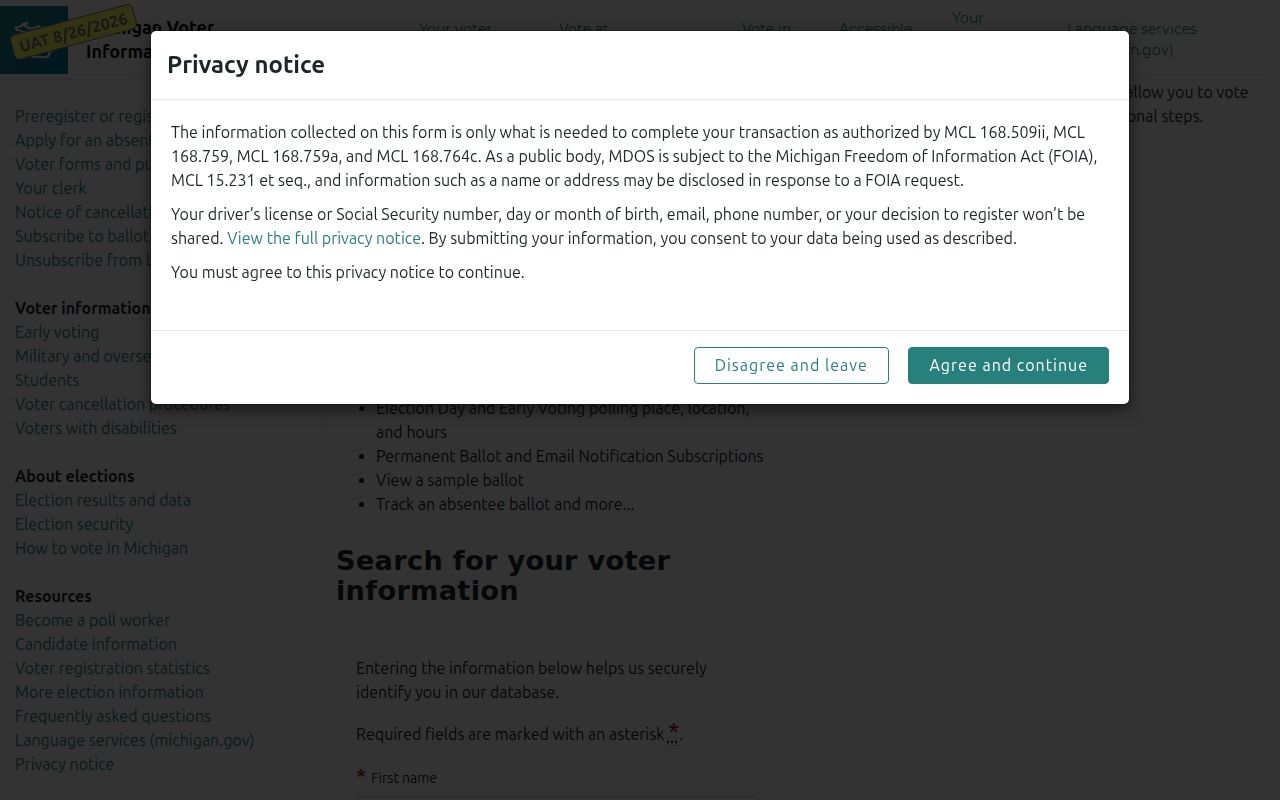
Michigan makes voter-registration records public through its records law, but it protects the month and day of birth, driver-license or state-ID number, phone, email, signature, and portions of Social Security information. A public Qualified Voter File request has its own field choices and redactions, so the requested scope should be narrow and tied to a lawful question.
Note: Michigan does not register voters by political party, so party is not a Detroit voter-search field.
Detroit Court Name Matches
A Detroit court result must be read as an index lead, not identity proof. The 36th District Court Case Inquiry offers no-charge public Registers of Action for cases filed in that court generally from 1990 to the present. It has no document images. The court advises users to find a case by name and then use the case number, and its schedule search is capped at 1,000 proceedings. A record from this limited-jurisdiction court says nothing about a person with the same name in another court.
The 36th Court inquiry entry leads to the public case and schedule routes.
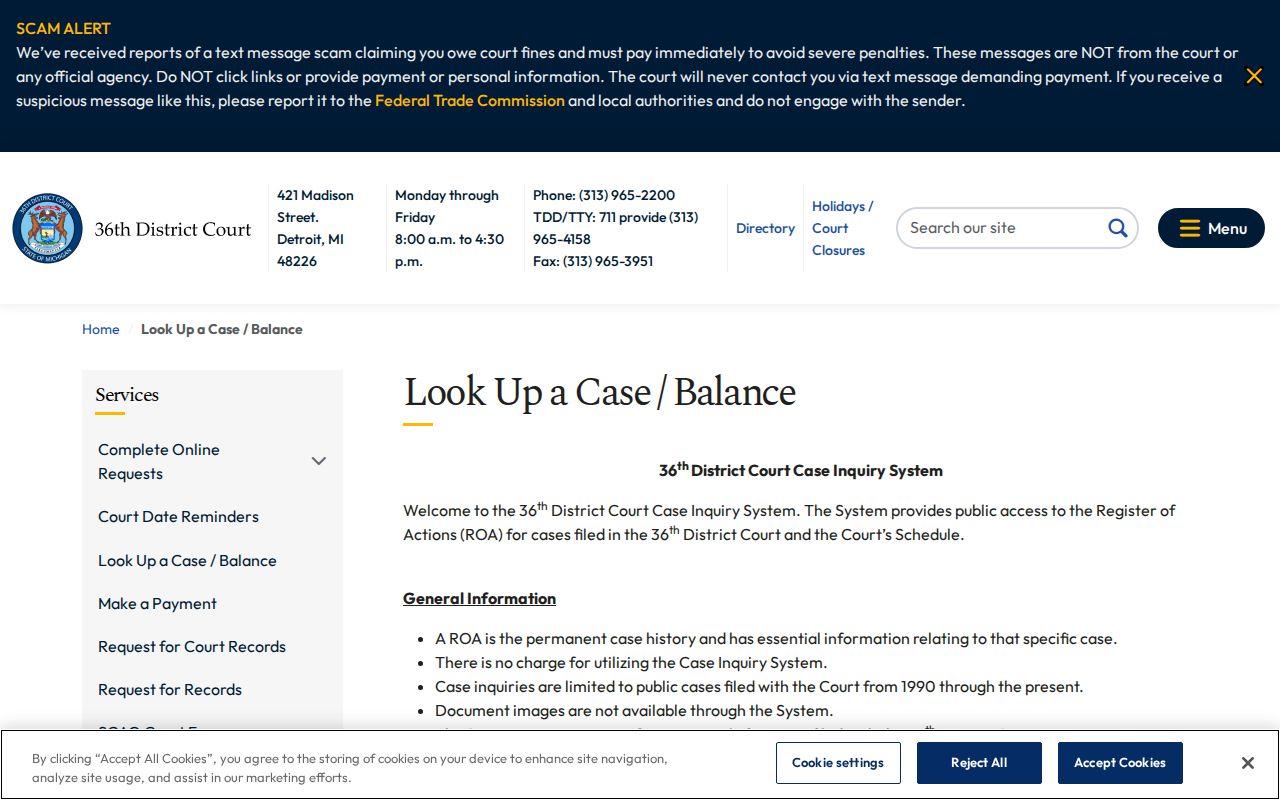
For circuit matters, Third Circuit Odyssey Public Access supplies limited public results, Registers of Action, and civil judgments. Party-filed documents are not online, while kiosks and paper records remain routes through the Clerk. Wayne Probate Court has a different search model: exact case number, first and last name, or company name, with a 100-match maximum and limits on older, sealed, confidential, and certain image records.
| Party name | Spelling shown in the public case result; compare it with other dated records. |
|---|---|
| Case number | The case-specific identifier needed for precise court follow-up. |
| Case type or division | The court category that keeps similar names from being flattened into one result. |
| Event or filed date | The date context for a Register of Actions entry or hearing schedule. |
| Disposition or balance | Information that may appear where applicable, but must be read in the official file context. |
Detroit Vital Record Eligibility
Vital records are not a general shortcut for finding a person. Michigan restricts a birth record less than 100 years old under MCL 333.2882 to the person named, a named parent, legal guardian or representative, eligible heir, or a court order. Death, marriage, and divorce copies follow broader written-request and prepaid-fee rules under MCL 333.2882(1c) and (1d). The event type, date, and requester’s eligibility decide the proper route.
Wayne County’s Detroit birth-record page describes local ID, written-mail, counter, and authorized online-request requirements.
Wayne County’s Detroit Birth and Death Records Division serves local birth and death requests, while MDHHS Vital Records is the statewide custodian for Michigan events. The state documents mail, authorized online, telephone, drop-box, will-call, and appointment-only in-person channels. A historical question can also require a county, church, funeral-home, cemetery, probate, newspaper, or Burton index lead rather than a certificate request.
Michigan’s vital-record ordering page separates the event types and access channels.
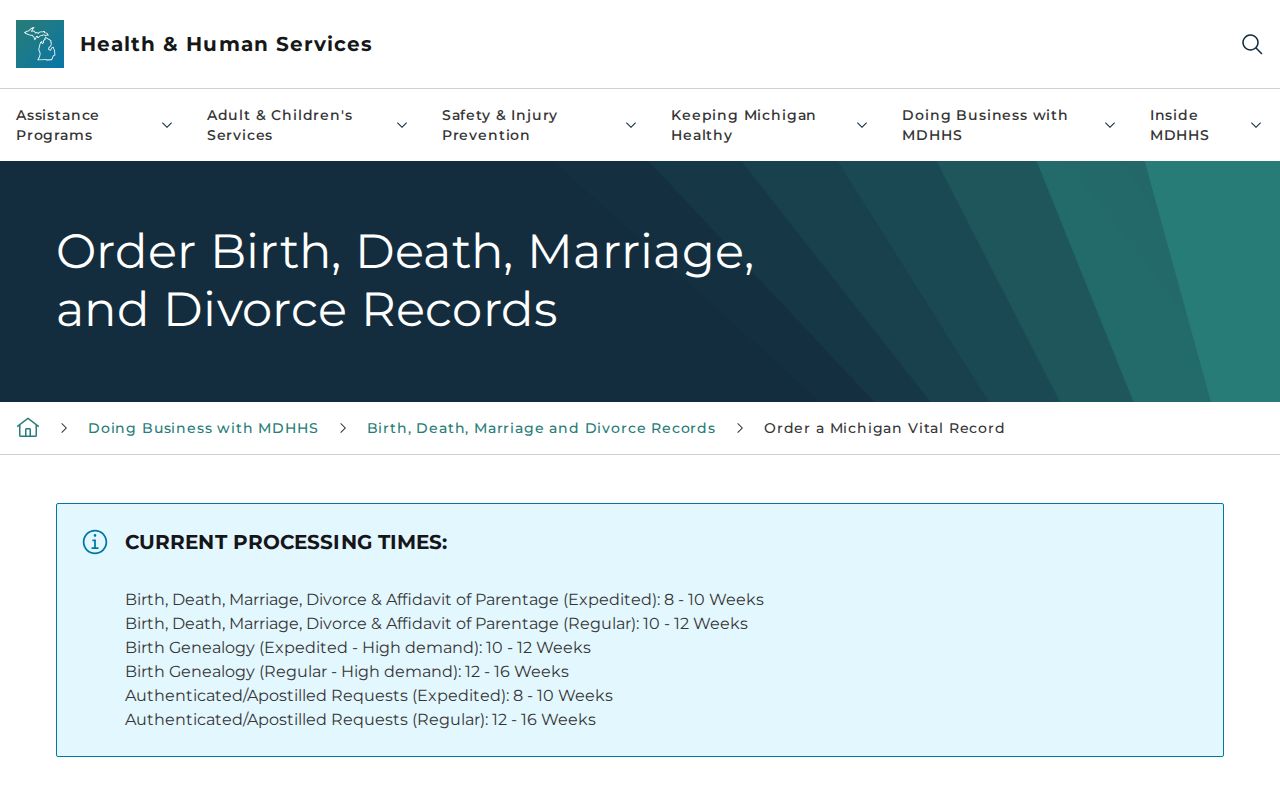
Birth, death, marriage, and divorce are distinct record systems. A divorce certificate is not the same as the court file, and a public index is not a certified copy. Confirm the current application, fee, and eligibility instructions with the office before sending identity documents or payment.
Verify a Detroit Resident Lookup
Start with one record that has a clear time and role. The goal is not to make a broad profile. It is to decide whether records refer to the same person at a relevant point in time. A Detroit property entry may show a corporate owner, trust, lender, prior owner, or taxpayer. A voter form has strict identity inputs. A court caption may name a different person with the same surname. Keep source dates separate, and ask the appropriate custodian for an official copy when the distinction matters.
- Normalize the name, including any middle initial, suffix, former surname, and spelling variation. Keep an old Detroit address separate from its current form.
- Confirm the geography with a parcel, address, or municipal source. A Detroit mailing ZIP alone does not prove the address lies in Detroit.
- Use one official record as an anchor, then compare only independent records that share a date, address, year, family connection, or case number.
- Label the result by its actual role, such as owner, taxpayer, court party, voter record, heir, directory occupant, or license holder. Request a certified record from the custodian if required.
- Docket
- A court’s running list of filings, events, and actions in a specific case.
- Index and image
- An index points to a record; an image is the scanned document when public access includes it.
- Certified copy
- A custodian-issued copy carrying the office’s certification, rather than a convenience display or index entry.
Detroit historical addresses need added care. The citywide renumbering effective January 1, 1921 can make an old directory number fail in a current system. Burton’s historical materials and the old-to-new address bridge can help establish the correct historic location before a name is compared.
Note: A same-name court or property entry is only a lead until independent facts support the match.
Detroit Business Role Checks
Sometimes a Detroit resident lookup reaches a public business or licensed-professional record. That route can confirm a named role or credential at a stated time, but it cannot prove a home address. The LARA license search can show a public licensee, profession, status, issue or expiration date, discipline, and some address or specialty information where reported. A public search is different from LARA’s certified verification process.
The Michigan Corporations Division’s MiBusiness Registry launched in 2025 and supports entity, individual, ID, and filing searches. Its documented individual roles include agent, officer, director, shareholder, member, manager, and general partner. An entity’s registered office can be a service location or agent address, so it needs a role label and a filing date.
Note: Preserve a license status and filing date because current public pages can differ from older records.
Detroit Resident Lookup FOIA Route
When a documented public record is not online, Michigan Freedom of Information Act requests can be a focused fallback. Michigan FOIA, 1976 PA 442, MCL 15.231 et seq., calls for a written request that describes the record well enough for the public body to find it. The request should name the Detroit or Wayne County office, record type, date range, address, case number, permit number, or parcel number that limits the search. It is not a request for every record connected to a name.
Michigan’s FOIA guidance describes the five-business-day response period and a possible ten-business-day extension. Permitted charges can include search, review, separation of exempt material, copying, and mailing. The office may redact protected material or direct a requester to a different custodian. A narrow request is easier to process and reduces unnecessary disclosure.
Detroit Resident Lookup Safety Limits
Michigan public records have record-specific boundaries. Voter-file redactions protect sensitive identity fields. Courts withhold sealed, juvenile, adoption, confidential-family, and other excluded matters. A taxpayer mailing address may not be a parcel situs, and an owner name may not identify an occupant. The Michigan Address Confidentiality Program gives qualifying people a substitute address and mail-forwarding route. Do not attempt to reverse an ACP address or infer a protected location from separate records.
Lawful use. Use Detroit resident lookup sources for personal, lawful research and verification. Do not use a record trail to stalk, harass, intimidate, or expose a protected person.
The 36th District Court also warns about fraudulent text messages. Verify a case balance or payment instruction through the court’s official page or published telephone number, not through a link sent in an unexpected message. If an official record appears incorrect, retain the exact URL, record date, and identifier, then use the custodian’s correction route.